
Five Healthcare Use Cases for the RHINO D2: From Patient Care to Asset Tracking


 Jannelle Selan
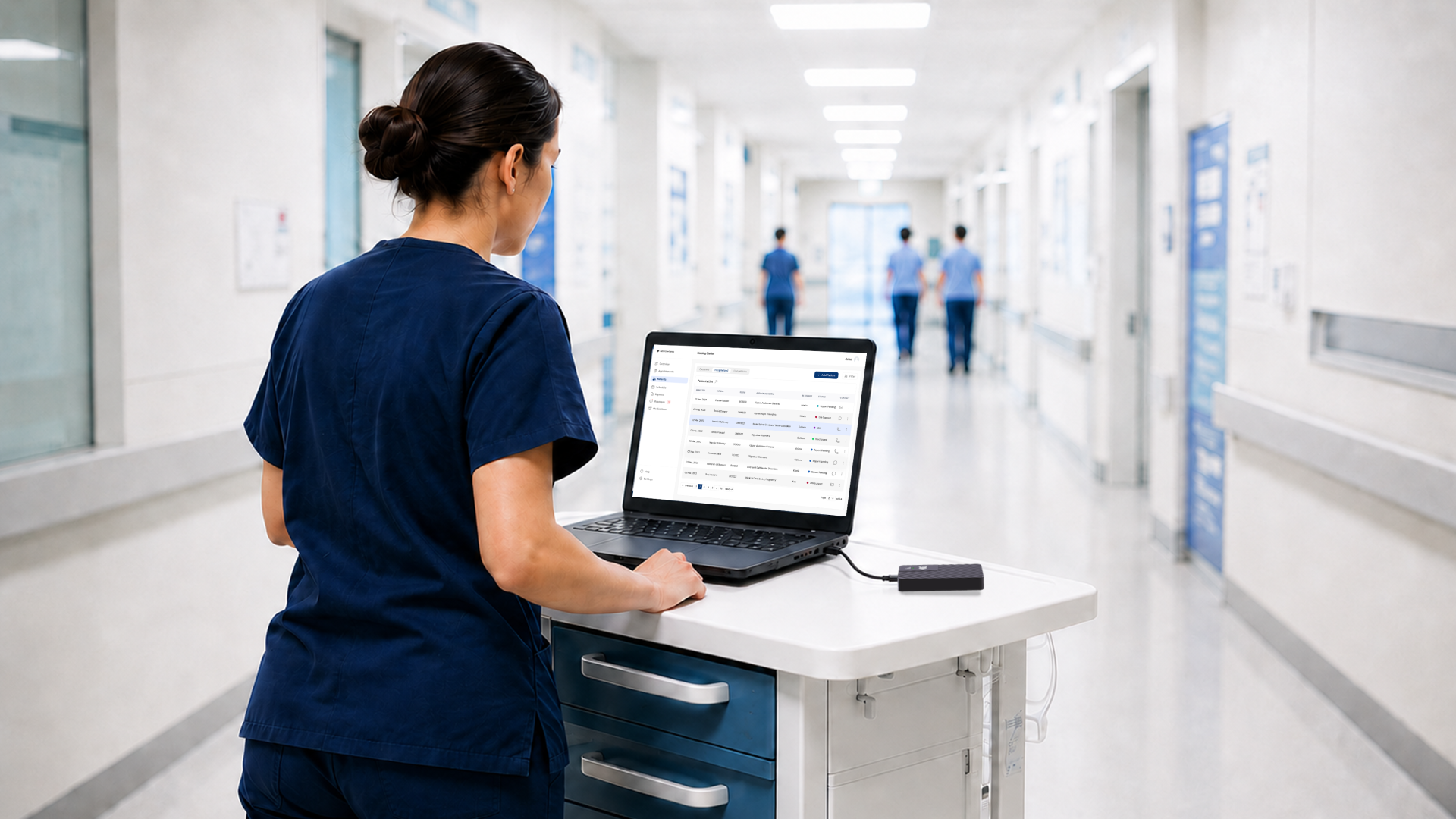
The RHINO D2 is a compact 5G RedCap dongle that adds instant, enterprise-grade connectivity to existing hardware. It connects over a standard USB port, enrolls automatically over eSIM with no manual setup, and gives IT centralized administration through Mambo, including GPS location tracking that can be turned on or off depending on the deployment.
In healthcare environments, those capabilities solve a specific problem: clinical devices need to stay online across inconsistent conditions without adding work for clinical staff. A nursing cart moving between units needs a connection that does not depend on facility Wi-Fi coverage. A home health clinician working a rural route needs a device that connects without a call to IT. A biomedical engineering team needs to know where a piece of mobile equipment actually is, not where it was last scanned.
Here are five ways this shows up in healthcare operations.
1. Mobile Nursing Carts and Computers on Wheels
Point-of-care documentation runs on carts and workstations that move constantly between rooms and floors in buildings where Wi-Fi coverage is often uneven. The RHINO D2 connects over a standard USB port, giving carts a reliable primary or backup 5G/LTE connection with no driver install and no manual carrier setup. Because devices enroll automatically over eSIM at first power-up, a large cart rollout can go live without an IT tech configuring each unit by hand.
Connectivity gaps on a cart are not just an inconvenience. When a cart drops connection mid-shift, documentation gets delayed, and staff fall back to paperwork that has to be re-entered into the record later. A consistent cellular connection as a backup to facility Wi-Fi removes one of the more common causes of that disruption.
2. Telehealth and Remote Patient Monitoring
Rural clinics, mobile health units, and remote monitoring programs often operate where fixed broadband is unreliable or unavailable. Since the RHINO D2 works across major US carriers and MVNOs, a healthcare organization is not stuck with whichever single carrier happens to cover a given location and can match connectivity to whichever network performs best there.
Video consult quality depends directly on connection stability, and a call that drops or lags undermines confidence in a telehealth visit regardless of the quality of care behind it. For programs expanding into new service areas, the ability to switch carriers on existing hardware, rather than sourcing new devices for each region, also removes a real barrier to scaling coverage.
3. Medical Equipment and Asset Tracking
Lost or misplaced equipment is a routine, expensive problem in healthcare facilities: wheelchairs, portable ultrasound machines, infusion pumps, and monitors go missing between departments regularly. The RHINO D2's GPS tracking can be turned on specifically for asset-tracking deployments or left off where location data is not needed. Paired with Mambo's device grouping and monitoring, a hospital system can track equipment across a campus from a single dashboard instead of relying on manual equipment counts.
Beyond locating misplaced items, consistent location data over time gives biomedical and facilities teams a clearer picture of how equipment is actually used across departments, which helps inform decisions about where equipment sits idle versus where demand consistently outpaces supply.
4. EMS, Ambulances, and Mobile Care Units
First responders need dependable connectivity for patient care reporting and live consults with receiving hospitals while moving through areas with inconsistent cellular coverage. The D2's plug-and-play design adds 5G and LTE to legacy and modern hardware alike, so an EMS agency does not need to replace its whole fleet to modernize connectivity.
Much of the hardware already installed in EMS vehicles, ruggedized laptops, mounted tablets, and reporting terminals, was not built with modern cellular connectivity included, and replacing it purely to gain a better connection is rarely in the budget. Adding connectivity to what is already installed is usually the more realistic path. Centralized management through Mambo also lets a fleet manager check connectivity status and push updates remotely, rather than pulling vehicles out of service for manual patching.
5. Home Health and Field Nursing
Field clinicians visiting patients at home need a connection that works without carrying a separate hotspot or waiting on a carrier contract. Because the D2 enrolls automatically and needs no IT setup to activate, a home health agency can ship devices straight to new field staff and have them working the moment they are powered on.
That matters for agencies dealing with regular staff turnover or geographic expansion, since a device can be reissued to a new clinician or redeployed to a new territory without a full re-provisioning process each time. Password-controlled access to the management interface also keeps network settings and roaming behavior under IT's control, even for devices that never touch an office network.
Built to Scale With Healthcare
Across all five of these use cases, the same problem keeps showing up: healthcare connectivity is not just about signal strength; it is about managing that connectivity at scale. One dongle is easy to keep track of. Hundreds of carts, ambulances, home health kits, and tracked assets spread across a health system are not, unless the connectivity layer was built for centralized management from the start.
For IT and biomedical engineering teams, that means the real decision is not just which device to buy, but how the fleet will be provisioned, secured, and monitored once hundreds of units are out in the field. Devices that enroll automatically, report status centrally, and can be reconfigured remotely turn what would otherwise be a growing maintenance burden into something a small team can manage from a single dashboard, even as the deployment scales into the hundreds or thousands of units.
That is the problem the RHINO D2 was built to solve: connectivity that a health system can deploy once and manage indefinitely, across whichever mix of carts, vehicles, and field devices its care model actually requires.
To see how Rhino Mobility supports connected care across a broader range of devices, visit our healthcare industry page.
Contact us to talk through how the RHINO D2 can fit into your organization's deployment.